


The whirling of helicopter rotors is likely to be probably the most feared sound in ski racing.Skiers carrying little greater than calmly padded bodysuits and helmets hurtling down icy snow at as much as 80 mph is horrifying sufficient. Crashing into security nets or tumbling uncontrolled is worse.Watching them being airlifted off the course — just about mummified in a stretcher, dangling in mid-air beneath a hovering chopper by a cable earlier than being whisked away over jagged peaks towards the closest hospital — is likely one of the gravest moments in sports activities.Lindsey Vonn is aware of the sound all too properly. When the American was airlifted off the Olympia delle Tofana course after a daunting head-over-heels fall throughout the Olympic downhill on Sunday, it led to her second such helicopter journey in 9 days. The primary crash, in a World Cup race in Switzerland, ruptured the ACL in her left knee; the second broke that very same leg, led to rapid surgical procedure and presumably ended her profession.“The helicopters add a component of drama to it that may be a bit heightened,” Anouk Patty, the chief of sport for U.S. Ski and Snowboard, mentioned shortly after Vonn’s newest evacuation. “However the actuality is it’s simply the quickest approach to get the athletes out to the clinic or the hospital the place they should go.”Helicopter rescues in Alpine ski racing require shut collaboration between native medical employees, crew physicians and pilots.Earlier than the Olympics, The Related Press interviewed Nicola Cherubin, the rescue specialist who was lowered from the helicopter and introduced Vonn as much as the plane with him on a rope and stayed alongside her whereas each have been hanging outdoors the cabin throughout flight.Privateness guidelines forestall Cherubin from discussing particulars of particular rescues, however he confirmed to The AP after Sunday’s crash that he directed the Vonn operation in Cortina.Helicopter evacuations ‘save lives’Worldwide Ski and Snowboard Federation guidelines require that “a rescue helicopter or medically equal evacuation methodology have to be accessible on a foundation according to native regulation” in any respect World Cup, world championship and Olympic downhill and super-G races.And whereas the rule doesn’t specify it, it truly implies that a minimum of two helicopters are required. As a result of if one chopper is named into motion after which has to fly away to a hospital, there must be a backup in place.About an hour earlier than the beginning of each race, helicopters fly into place. Wind, fog and different climate circumstances can floor helicopters, which may imply that races are canceled or postponed.Helicopter evacuations are sometimes thought of extra environment friendly than escorting injured athletes down icy and steep programs on sleds or toboggans, although sleds are nonetheless utilized in sure conditions.“It saves lives,” FIS president Johan Eliasch mentioned.When Italian skier Matteo Franzoso died following a crash in preseason coaching on a course with restricted security fences in Chile in September, a helicopter needed to be known as in to take him away. The delayed response led to requires improved security protocols.Nobody needs to listen to a code 3 relating to snowboarding accidentsThe helicopter crew consists of the pilot, emergency care physicians and a rescue specialist like Cherubin.“I am going down and deal with the safety on the bottom,” Cherubin mentioned. “Then we talk primarily based on varied codes: 01 or 2 implies that simply I am going down and take the athlete up. Then if it’s a Code 3, which suggests it’s extra critical, the physician comes down, too.”Injured athletes are first handled by a floor crew of medical personnel primarily based at intervals alongside the course in coordination with crew physicians from the nationwide groups concerned within the race.As soon as an injured athlete has been hooked as much as the rope, Cherubin tells the crew by way of radio when to begin reeling the rope as much as the helicopter, often bringing the stretcher up alongside the cabin however remaining outdoors.“When we now have brief flights of lower than a minute, it doesn’t make sense to get inside,” Cherubin mentioned. “It’s faster simply to remain outdoors and land that method.”In Cortina, the place the race end is midway up the mountain and never on the backside, injured athletes are picked up off the course and flown all the way down to a brief medical station. Medical personnel from the injured athlete’s crew can meet the skier there and assist determine on the following plan of action.The choices embrace utilizing one other, greater helicopter to airlift the athlete to a hospital trauma unit, taking the athlete by ambulance to a medical facility in Cortina, or releasing the athlete. In Bormio, the place males’s snowboarding is being contested throughout the Olympics, Andrea Borromini, an intensive care doctor who’s the chief of medical service for the Stelvio course, mentioned helicopter crews there can fly to 3 completely different medical amenities.In Vonn’s case, she was taken farther south, to a hospital in Treviso.“We regularly hear on TV that it’s a really critical harm as a result of the helicopter has come. However that’s not all the time true. It’s simply an evacuation system,” mentioned Andrea Apollonio, who’s answerable for the medical companies on the Cortina races.Typically the injured skiers do not know they have been hurtChemmy Alcott, a retired British downhiller turned BBC broadcaster, mentioned she has no reminiscence of being picked up by a helicopter when she suffered compound fractures of the tibia and fibula bones in her proper leg throughout a crash at Lake Louise, Alberta, in 2010.“Thankfully by that time, I’d been given some morphine. So I used to be beginning to lose my head a bit bit — to cease the screaming,” Alcott mentioned. “I solely bear in mind it as a result of I’ve seen it within the video.”Alcott can nonetheless relate to the thought course of, although, that skiers undergo once they understand they’ve misplaced management.“You get this loopy gradual movement focus,” she mentioned. “So you concentrate on your organs. You assume, ‘Proper, how am I going to guard my neck, my again?’ You’re going, ‘OK, that is how I’m going to fall.’ After which you’ve an enormous quantity of adrenaline, so that you by no means really feel ache within the first like 30 seconds. After which it hits you and also you’re doing all of your form of physique scan from high to backside, and that’s when issues are dangerous.”The emergency care physicians within the helicopter crew know that coping with athletes instantly after they’re injured is nothing like what they take care of of their day jobs.“They all the time wish to rise up immediately. So we now have to immobilize them after which re-examine them,” mentioned Lydia Rauch, an anesthesiologist who has been within the helicopter crew for years at races in Val Gardena and Cortina. “I’ve handled athletes with severely damaged bones who instructed me that nothing was hurting them. And there may be different inside accidents you could’t discover immediately.”The sound of the helicopter blades may be disturbing to the following skier ready to begin and already coping with an extended delay because of the crash.Austrian racer Mirjam Puchner was the unlucky skier in that place for Vonn’s crash on Sunday. Since Vonn fell only a few gates into her run, the helicopter was just about at eye degree for Puchner.“All that point you’re listening to that, it’s enjoying in your nerves,” mentioned Puchner, who was disillusioned together with her Eleventh-place end.She mentioned she has no reminiscence of her personal helicopter evacuation when she broke her proper leg in a fall throughout downhill coaching on the 2017 world championships in St. Moritz, Switzerland.“I awakened within the hospital,” she mentioned.___AP Sports activities Author Pat Graham in Bormio contributed.
The whirling of helicopter rotors is likely to be probably the most feared sound in ski racing.
Skiers carrying little greater than calmly padded bodysuits and helmets hurtling down icy snow at as much as 80 mph is horrifying sufficient. Crashing into security nets or tumbling uncontrolled is worse.
Watching them being airlifted off the course — just about mummified in a stretcher, dangling in mid-air beneath a hovering chopper by a cable earlier than being whisked away over jagged peaks towards the closest hospital — is likely one of the gravest moments in sports activities.
Lindsey Vonn is aware of the sound all too properly. When the American was airlifted off the Olympia delle Tofana course after a daunting head-over-heels fall throughout the Olympic downhill on Sunday, it led to her second such helicopter journey in 9 days. The primary crash, in a World Cup race in Switzerland, ruptured the ACL in her left knee; the second broke that very same leg, led to rapid surgical procedure and presumably ended her profession.
“The helicopters add a component of drama to it that may be a bit heightened,” Anouk Patty, the chief of sport for U.S. Ski and Snowboard, mentioned shortly after Vonn’s newest evacuation. “However the actuality is it’s simply the quickest approach to get the athletes out to the clinic or the hospital the place they should go.”
Helicopter rescues in Alpine ski racing require shut collaboration between native medical employees, crew physicians and pilots.
Earlier than the Olympics, The Related Press interviewed Nicola Cherubin, the rescue specialist who was lowered from the helicopter and introduced Vonn as much as the plane with him on a rope and stayed alongside her whereas each have been hanging outdoors the cabin throughout flight.
Privateness guidelines forestall Cherubin from discussing particulars of particular rescues, however he confirmed to The AP after Sunday’s crash that he directed the Vonn operation in Cortina.
Helicopter evacuations ‘save lives’
Worldwide Ski and Snowboard Federation guidelines require that “a rescue helicopter or medically equal evacuation methodology have to be accessible on a foundation according to native regulation” in any respect World Cup, world championship and Olympic downhill and super-G races.
And whereas the rule doesn’t specify it, it truly implies that a minimum of two helicopters are required. As a result of if one chopper is named into motion after which has to fly away to a hospital, there must be a backup in place.
About an hour earlier than the beginning of each race, helicopters fly into place. Wind, fog and different climate circumstances can floor helicopters, which may imply that races are canceled or postponed.
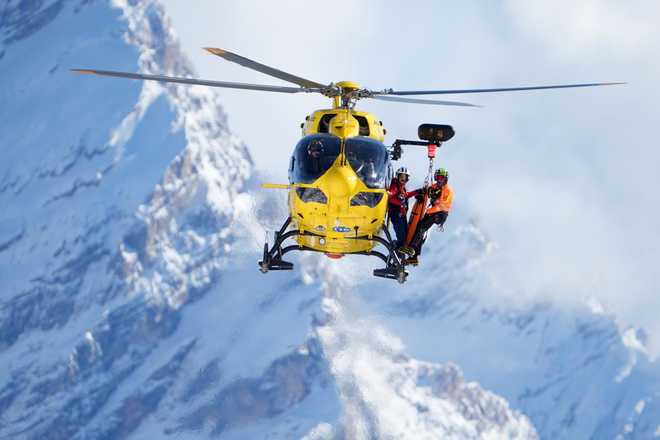
Helicopter evacuations are sometimes thought of extra environment friendly than escorting injured athletes down icy and steep programs on sleds or toboggans, although sleds are nonetheless utilized in sure conditions.
“It saves lives,” FIS president Johan Eliasch mentioned.
When Italian skier Matteo Franzoso died following a crash in preseason coaching on a course with restricted security fences in Chile in September, a helicopter needed to be known as in to take him away. The delayed response led to requires improved security protocols.
Nobody needs to listen to a code 3 relating to snowboarding accidents
The helicopter crew consists of the pilot, emergency care physicians and a rescue specialist like Cherubin.
“I am going down and deal with the safety on the bottom,” Cherubin mentioned. “Then we talk primarily based on varied codes: 01 or 2 implies that simply I am going down and take the athlete up. Then if it’s a Code 3, which suggests it’s extra critical, the physician comes down, too.”
Injured athletes are first handled by a floor crew of medical personnel primarily based at intervals alongside the course in coordination with crew physicians from the nationwide groups concerned within the race.
As soon as an injured athlete has been hooked as much as the rope, Cherubin tells the crew by way of radio when to begin reeling the rope as much as the helicopter, often bringing the stretcher up alongside the cabin however remaining outdoors.
“When we now have brief flights of lower than a minute, it doesn’t make sense to get inside,” Cherubin mentioned. “It’s faster simply to remain outdoors and land that method.”
In Cortina, the place the race end is midway up the mountain and never on the backside, injured athletes are picked up off the course and flown all the way down to a brief medical station. Medical personnel from the injured athlete’s crew can meet the skier there and assist determine on the following plan of action.
The choices embrace utilizing one other, greater helicopter to airlift the athlete to a hospital trauma unit, taking the athlete by ambulance to a medical facility in Cortina, or releasing the athlete. In Bormio, the place males’s snowboarding is being contested throughout the Olympics, Andrea Borromini, an intensive care doctor who’s the chief of medical service for the Stelvio course, mentioned helicopter crews there can fly to 3 completely different medical amenities.
In Vonn’s case, she was taken farther south, to a hospital in Treviso.
“We regularly hear on TV that it’s a really critical harm as a result of the helicopter has come. However that’s not all the time true. It’s simply an evacuation system,” mentioned Andrea Apollonio, who’s answerable for the medical companies on the Cortina races.
Typically the injured skiers do not know they have been harm
Chemmy Alcott, a retired British downhiller turned BBC broadcaster, mentioned she has no reminiscence of being picked up by a helicopter when she suffered compound fractures of the tibia and fibula bones in her proper leg throughout a crash at Lake Louise, Alberta, in 2010.
“Thankfully by that time, I’d been given some morphine. So I used to be beginning to lose my head a bit bit — to cease the screaming,” Alcott mentioned. “I solely bear in mind it as a result of I’ve seen it within the video.”
Alcott can nonetheless relate to the thought course of, although, that skiers undergo once they understand they’ve misplaced management.
“You get this loopy gradual movement focus,” she mentioned. “So you concentrate on your organs. You assume, ‘Proper, how am I going to guard my neck, my again?’ You’re going, ‘OK, that is how I’m going to fall.’ After which you’ve an enormous quantity of adrenaline, so that you by no means really feel ache within the first like 30 seconds. After which it hits you and also you’re doing all of your form of physique scan from high to backside, and that’s when issues are dangerous.”
The emergency care physicians within the helicopter crew know that coping with athletes instantly after they’re injured is nothing like what they take care of of their day jobs.
“They all the time wish to rise up immediately. So we now have to immobilize them after which re-examine them,” mentioned Lydia Rauch, an anesthesiologist who has been within the helicopter crew for years at races in Val Gardena and Cortina. “I’ve handled athletes with severely damaged bones who instructed me that nothing was hurting them. And there may be different inside accidents you could’t discover immediately.”
The sound of the helicopter blades may be disturbing to the following skier ready to begin and already coping with an extended delay because of the crash.
Austrian racer Mirjam Puchner was the unlucky skier in that place for Vonn’s crash on Sunday. Since Vonn fell only a few gates into her run, the helicopter was just about at eye degree for Puchner.
“All that point you’re listening to that, it’s enjoying in your nerves,” mentioned Puchner, who was disillusioned together with her Eleventh-place end.
She mentioned she has no reminiscence of her personal helicopter evacuation when she broke her proper leg in a fall throughout downhill coaching on the 2017 world championships in St. Moritz, Switzerland.
“I awakened within the hospital,” she mentioned.
___
AP Sports activities Author Pat Graham in Bormio contributed.


