


This piece was first printed at Legislation Dork.
It was, as Justice Elena Kagan defined lower than every week in the past, a undertaking of the U.S. Supreme Courtroom’s conservative majority for greater than a decade to destroy the Voting Rights Act. However, as soon as it was completed, the Republican appointees and their fellow vacationers in Louisiana moved instantly to implement their ruling.
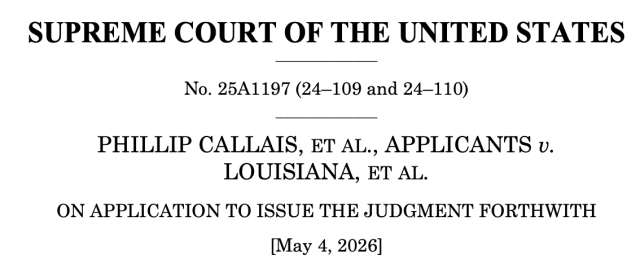
The Supreme Courtroom on Monday — simply 5 days after the courtroom’s Callais resolution — issued an order placing the ruling into impact instantly, bypassing the unusual month that the courtroom waits earlier than sending the judgment again to the decrease courts (at which level the decrease courts really implement the rulings).
Though I famous the ruling final evening, I wished to spend a while as we speak diving into the various issues with and brought on by the courtroom’s order issuing the judgment “forthwith.“
“Gov. Jeff Landry used an emergency statute typically used to deal with hurricanes to droop the congressional — and no different — elections.“
In an unusual authorized system, even one which issued the Callais resolution, the timing of the ruling was vital. The 32-day interval at difficulty would have meant the first elections would have been accomplished earlier than the judgment returned to the decrease courts, and the state would have operated underneath its present maps this yr, with loads of time to cross a brand new map for the 2028 elections.

However, actors in any respect ranges — Louisiana’s governor (and different statewide officers), the three-judge district courtroom, and the Supreme Courtroom — determined not to do this. As an alternative, Gov. Jeff Landry suspended the congressional major elections, the three-judge district courtroom set a schedule for briefing, and the Supreme Courtroom granted the Callais plaintiffs’s request to ship down the judgment instantly.
Stretching, if not ignoring, guidelines
All three actions concerned stretching, if not ignoring, the foundations which are presupposed to constrain the individuals in these roles.
Landry used an emergency statute typically used to deal with hurricanes to droop the congressional — and no different — elections. The three-judge district courtroom started performing instantly, ordering follow-on briefing earlier than it had the Supreme Courtroom’s judgment despatched to it. And, on Monday, the Supreme Courtroom shortened the 32 days to five.

As Justice Ketanji Brown Jackson wrote in dissenting from Monday’s order, “Apparently, neither the Governor nor the three-judge courtroom considered themselves as restricted by the truth that this Courtroom had but to difficulty its licensed judgment in these circumstances; within the unusual course, we don’t achieve this till at the very least 32 days after the opinion is launched.”
To the Supreme Courtroom’s actions on Monday particularly, she wrote, “Not content material to have determined the legislation, it now takes steps to affect its implementation. The Courtroom’s resolution to buck our ordinary observe underneath Rule 45.3 and difficulty the judgment forthwith is tantamount to an approval of Louisiana’s rush to pause the continued election with a view to cross a brand new map.“ (Jackson’s dissent additionally prompted a defensive concurring opinion issued by Justice Sam Alito, who was joined by Justices Clarence Thomas and Neil Gorsuch, suggesting that it was she — not the bulk — who was “creat[ing] the looks of partiality” right here.)
By Tuesday afternoon, the hazard of such rush was clear.
Within the courtroom’s one-paragraph order, it said, “[W]hile the Robinson appellants” who had introduced the underlying Voting Rights Act case that led to the order requiring the second alternative district in Louisiana “oppose [the Callais plaintiffs’ request], they haven’t expressed any intent to ask this Courtroom to rethink its judgment.“
The Robinson plaintiffs, nevertheless, challenged that declare in a request filed Tuesday, asking the courtroom to recall the mandate as a result of the courtroom’s order was based mostly on inaccurate data:
The only foundation cited within the Order for granting Appellees’ Utility and issuing the judgment forthwith was that “[RobinsonAppellants] haven’t expressed any intent to ask this Courtroom to rethink its judgment.” Nevertheless, within the second sentence of Appellants’ opposition to the Utility, Appellants requested “the chance to contemplate in search of rehearing.”
The Robinson plaintiffs went on to state that they do, actually, “intend to request rehearing on this case.“ Accordingly, they requested the courtroom to recall the judgment to permit them time to file such a request.

The actual-word injury of the frenzy was additionally made clear, because the Louisiana Illuminator’s Piper Hutchinson reported on Tuesday morning that “[t]he Louisiana Secretary of State acquired greater than 42,000 absentee ballots from voters for the Might 16 election by the point Gov. Jeff Landry suspended primaries final week for the state’s six U.S. Home races, in keeping with data officers offered Monday.”
Additional nonetheless, and other than the actions of the previous six day, you will need to do not forget that all of this chaos is of the Supreme Courtroom’s personal making.
The courtroom had initially acquired the request from Louisiana to listen to this case on July 30, 2024. The courtroom agreed to listen to the case on November 4, 2024. It was argued on March 24, 2025. On June 27, 2025, the courtroom introduced it was holding over the case for reargument within the fall. On August 1, 2025, the courtroom requested the events to offer briefing on the constitutional query. Arguments have been held on October 15, 2025. On April 29, 2026, the courtroom issued its ruling — after ballots had been mailed and even submitted and days earlier than early voting was set to start.
One final word about hypocrisy. Positive, there’s a lot to be discovered within the actions of the previous week — significantly relating to the pace which which the courtroom can act when it desires to take action and the interminable slowness of different moments (see, e.g., the immunity case). However I’d identical to to level out one thing that stood out to me as I learn Alito’s indignant concurrence.
Final August, Gorush warned of “anarchy” when decrease courts couldn’t divine the right that means from barebones shadow docket rulings. On Tuesday, Gorsuch joined Alito in waving the go-ahead flag to a governor and decrease courtroom unwilling to even look forward to the ruling to be formally transmitted earlier than they acted.

For the previous 15 years, Chris Geidner has been one of many key reporters within the nation protecting the Supreme Courtroom and our authorized system, a lot of it because the authorized editor and Supreme Courtroom correspondent at BuzzFeed Information.
Associated


